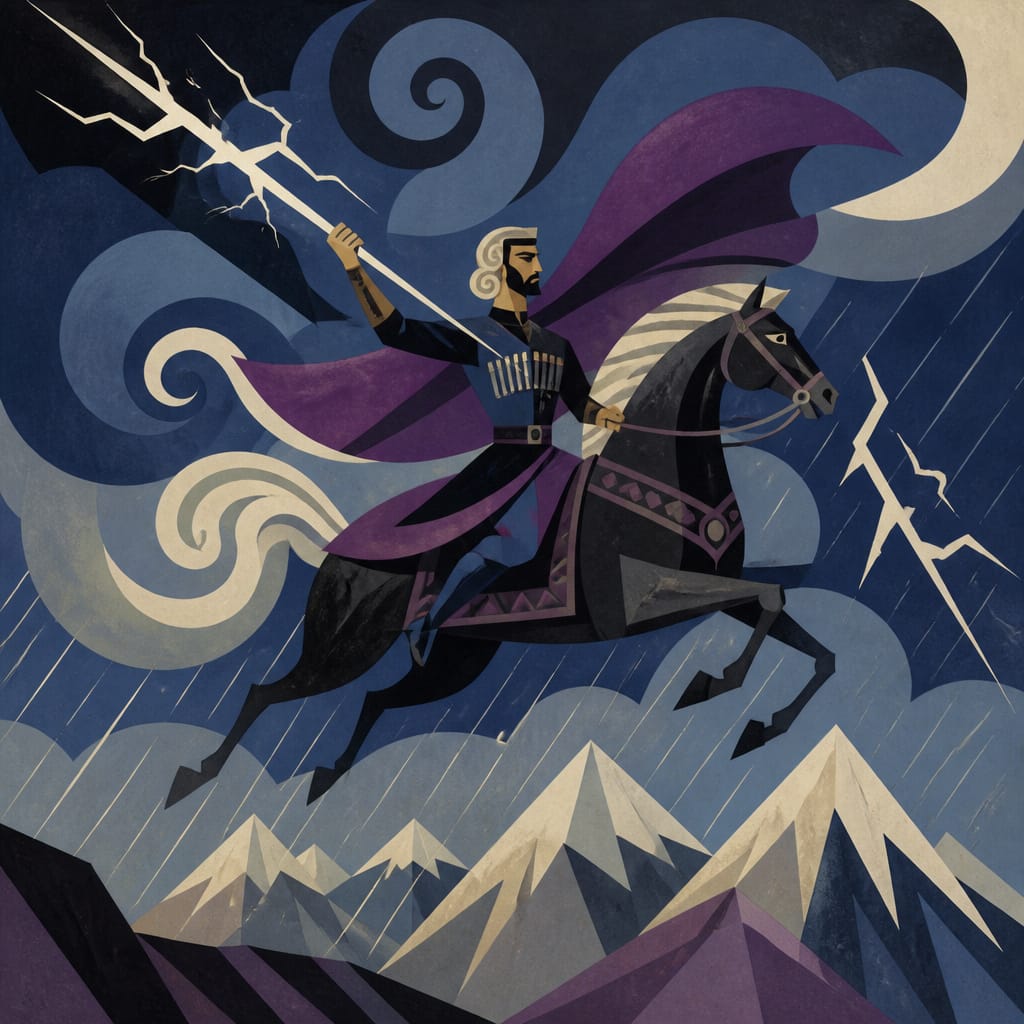
Shible
Deity of thunder, lightning, war, and justice. Those struck by lightning are considered blessed.
Mythology
Shible rides the storm on a black horse whose hooves strike the sparks men call lightning. He is the visible arm of judgment: where Tha is silent, Shible speaks in the sky. The Narts feared no enemy so much as an unjust cause under Shible's weather.
A person or tree struck by lightning was not mourned in the ordinary way but honored — the strike marked a soul touched directly. Communities gathered at such a place, danced the khurey around it, and often planted or preserved the wood as a shrine. Warriors invoked Shible before battle, but only after stating their cause aloud, since a false cause invited the bolt to turn.
Sacred Correspondences
- ·Thunder and lightning
- ·Righteous war
- ·Judgment and oath-testing
- ·Rain that breaks a drought
- ·The black horse
- ·Storm clouds
- ·High ridges and lightning-struck trees
- ·The battlefield
- ·The place where an oath is sworn
- ·Roasted meat shared with everyone present
- ·A cup of makhsyma poured onto the ground at the first thunder
- ·Iron: a nail, a blade laid flat
- ·A song sung outdoors in the rain
- ·Storm grey
- ·Iron black
- ·White-blue of the bolt
- ·Seven (the seven claps)
- ·Three
- ·Never invoke Shible for a cause you know to be unjust.
- ·Do not mock a thunderstorm, curse the rain, or shelter contemptuously from it.
- ·Do not cut or burn a lightning-struck tree for firewood.
- ·Do not swear by Shible in a private quarrel; his oaths are public.
Establishing a Relationship
Shible is approached by people who need to be held to a standard. Speak your intentions out loud, in the open air, where weather can hear them — and then live as if they were witnessed. Those who work with him report that he is quick, blunt, and unsentimental.
Go outdoors during storms rather than away from them. Learn one Nart tale of Shible or Batraz by heart and recite it when thunder starts. Keep a piece of iron on your altar and handle it whenever you are tempted to a convenient lie.
A Ritual
- 1Wait for a day of rising wind or distant thunder; go to a high, open place.
- 2Lay a piece of iron on the ground before you and stand behind it.
- 3Name your cause plainly and briefly: what you intend and why it is just.
- 4Pour a measure of makhsyma or ale onto the earth beside the iron.
- 5Say: "Shible, if this is true, ride with me; if it is false, turn."
- 6Stay until the weather passes over you. Take the iron home and keep it where you will see it daily.
Never perform this rite for something you would be ashamed to say in front of your community.
Rituals presented here are respectful reconstructions drawn from ethnographic description and contemporary Khabze practice, compiled by an outsider for educational purposes. Practice varies by family, village, and diaspora community.