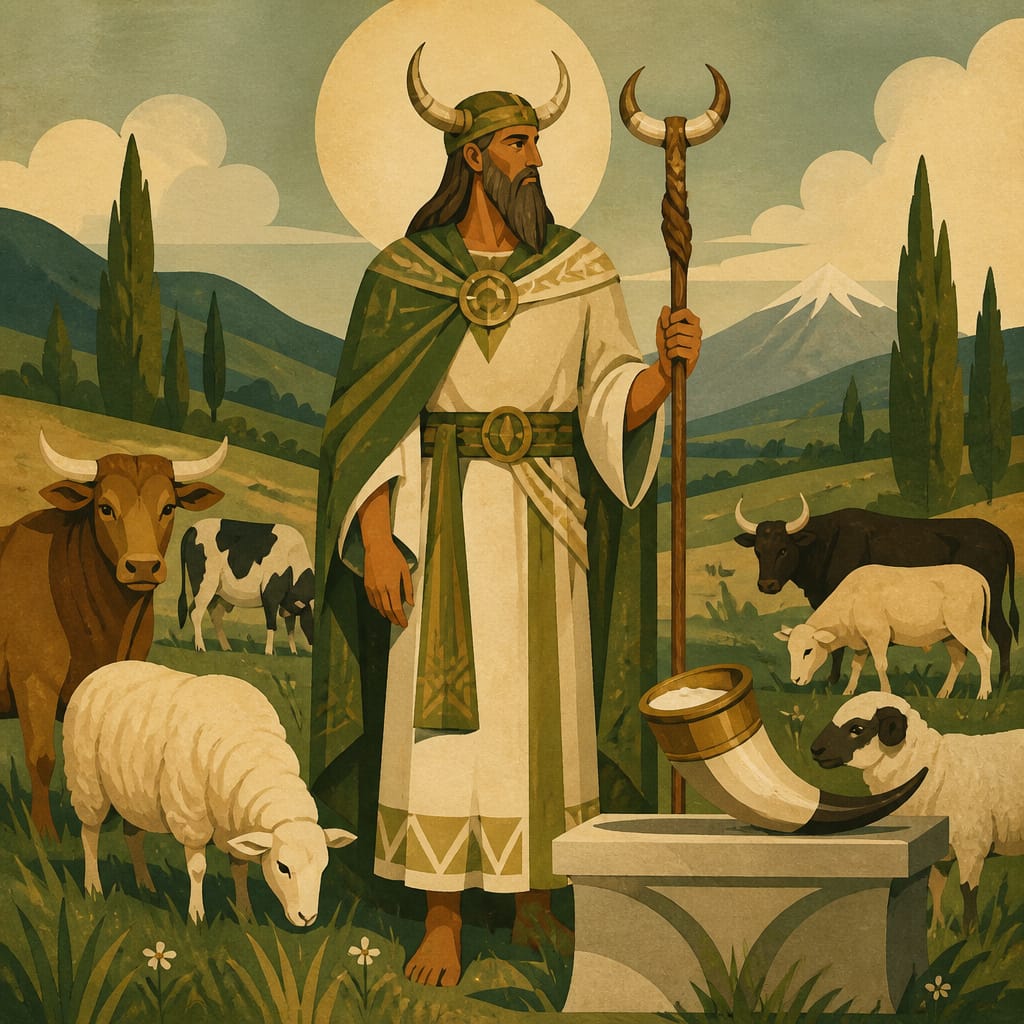
Amish
Guardian of sheep and shepherds; keeper of the flocks.
Mythology
Amish keeps the domestic herds as Mezythe keeps the wild ones. He walks the high summer pastures with a horned staff, counting; shepherds said that a flock which came down whole in autumn had been counted by him.
He is the god of patient custody — of the animal that cannot protect itself and the person who has accepted responsibility for it. Old herding songs address him directly by name, sung to calm the animals as much as to petition him.
Sacred Correspondences
- ·Sheep, goats, cattle
- ·Shepherds and herders
- ·Summer pasture and transhumance
- ·Wool, milk, cheese
- ·Guardianship of the vulnerable
- ·High pastures
- ·Pens and folds
- ·Mountain paths between summer and winter grazing
- ·The first milk of a season
- ·White cheese
- ·A tuft of wool tied to a fence post
- ·A song sung to the animals
- ·Wool white
- ·Pasture green
- ·Grey stone
- ·Four (the seasons of the herding year)
- ·Hundred (the whole flock)
- ·Do not mistreat, frighten, or overwork an animal in your care.
- ·Do not slaughter carelessly or without thanks.
- ·Do not count the flock boastfully in front of others.
- ·Do not abandon a responsibility you took on freely.
Establishing a Relationship
Amish is for anyone who is responsible for a dependent being — animals, children, patients, students. His practice is the daily check: go and see, count, notice the one that is limping.
Keep something woolen on your altar. Learn a lullaby or herding song and sing it to whatever you are looking after.
A Ritual
- 1At dusk, go to those in your care — animals, family, or a written list of obligations.
- 2Count them aloud, one by one, naming each.
- 3Name any that are unwell, struggling, or missing.
- 4Set out a small dish of milk and a piece of white cheese.
- 5Say: "Amish, they are counted. Bring them down whole."
- 6Do one concrete thing tonight for whichever one you named as struggling.
Rituals presented here are respectful reconstructions drawn from ethnographic description and contemporary Khabze practice, compiled by an outsider for educational purposes. Practice varies by family, village, and diaspora community.