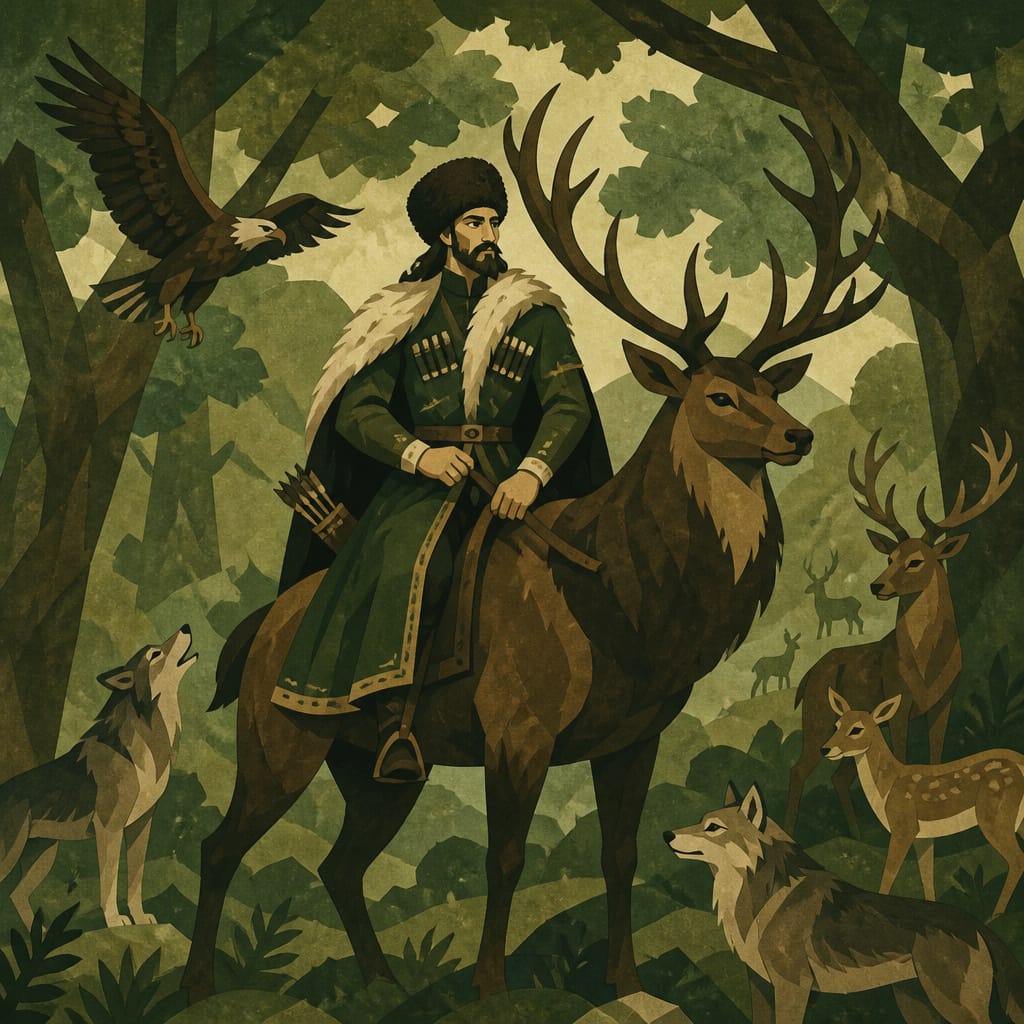
Mezythe
God of the forest and the hunt. The stag is his familiar; hunters ask before they take.
Mythology
Mezythe rides a great stag through the old-growth forest, wolves at his flank and birds ahead of him. He owns the game; hunters do not take animals, they receive them. A hunter who kills more than needed, or who fails to ask, finds the forest closed: no tracks, no sound, no luck for a season.
In the sagas he appears as a courteous host who becomes implacable when insulted. Hunting parties sang to him on the way out and left a share of the kill at the treeline on the way back.
Sacred Correspondences
- ·Forests and old growth
- ·Stags, wolves, hunting dogs
- ·Restraint and sufficiency
- ·Wild permission
- ·Antler and bone
- ·Deep woodland
- ·Game trails and clearings
- ·The treeline
- ·A share of any hunt or foraged food left at the forest edge
- ·A hunting song sung aloud on entering
- ·Salt
- ·Removing litter from the woods
- ·Forest green
- ·Bark brown
- ·Antler cream
- ·Three (asking, taking, thanking)
- ·Twelve (the stag's tines)
- ·Never take more than you need, and never take a nursing or pregnant animal.
- ·Do not enter the woods without asking, or leave without thanking.
- ·Do not boast about a kill or display it as a trophy.
- ·Do not leave waste, wounded animals, or fire behind you.
Establishing a Relationship
Mezythe is a landlord, not a friend. The relationship is built entirely on manners: ask at the edge, take little, thank at the edge. Learn the actual species of your local forest — he does not respond to generic reverence.
Walk the same stretch of woodland repeatedly across a year until you know what changes. Carry out more than you carry in.
A Ritual
- 1Stop where the woods begin; do not step past the first trees yet.
- 2Say aloud who you are and what you have come for — wood, berries, game, or only walking.
- 3Leave a pinch of salt or a piece of bread on a stone at the edge.
- 4Wait for three breaths. If the woods feel closed, come back another day.
- 5Take only what you named. Damage nothing else.
- 6Returning, stop at the same stone, name what you took, and say thanks aloud. Carry out any litter you found.
Rituals presented here are respectful reconstructions drawn from ethnographic description and contemporary Khabze practice, compiled by an outsider for educational purposes. Practice varies by family, village, and diaspora community.