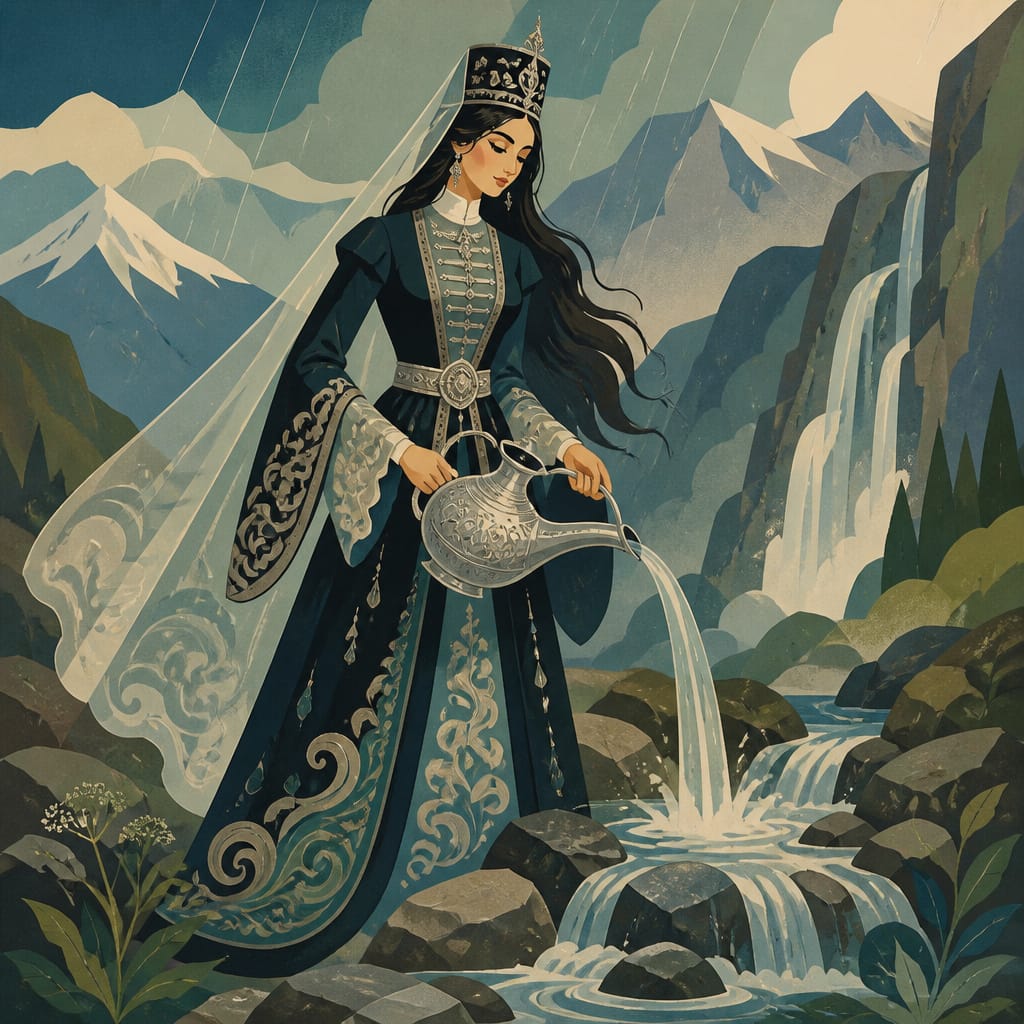
Hantseguash
The Goddess of Water and Rain.
Mythology
Hantseguash is the rain-bringer, invoked in drought by one of the best-attested Circassian rites: a wooden shovel or frame was dressed as a woman and carried in procession through the village to the river, where the crowd doused it — and each other — with water.
Everyone met along the way poured water over the effigy and gave food; the whole village then ate together at the bank. She is a goddess of collective need rather than private petition — she answers communities.
Sacred Correspondences
- ·Rain and drought-breaking
- ·Rivers and irrigation
- ·Village processions
- ·Communal feasting
- ·The dressed effigy
- ·Rainclouds
- ·Riverbanks
- ·Fields waiting on water
- ·Water poured over an image or stone
- ·Food shared publicly
- ·Songs sung in procession
- ·Cloth or a scarf tied at the river
- ·Rain grey
- ·Deep blue
- ·White
- ·Three
- ·Seven
- ·Do not perform her rain rite alone or in secret — it requires company.
- ·Do not waste water in her season.
- ·Do not mock the rite or those who take part.
- ·Do not petition her for personal gain during a communal drought.
Establishing a Relationship
Hantseguash is best approached with other people. Organise something communal — a shared meal, a river cleanup, a neighbourhood gathering — and dedicate it to her.
Privately, pay attention to water use: track it, reduce it, and give thanks at rainfall. Step outside during rain rather than avoiding it.
A Ritual
- 1Gather at least two other people. Dress a wooden spoon, staff, or stone in cloth as a simple figure.
- 2Carry it together to a river, stream, or standing water, singing or talking as you go.
- 3Each person pours water over the figure in turn, saying what they need rain for.
- 4Set the figure at the water's edge and douse one another lightly with water.
- 5Share a meal on the bank; leave a portion at the waterline.
- 6Carry the figure home dry and keep it until next needed.
Rituals presented here are respectful reconstructions drawn from ethnographic description and contemporary Khabze practice, compiled by an outsider for educational purposes. Practice varies by family, village, and diaspora community.