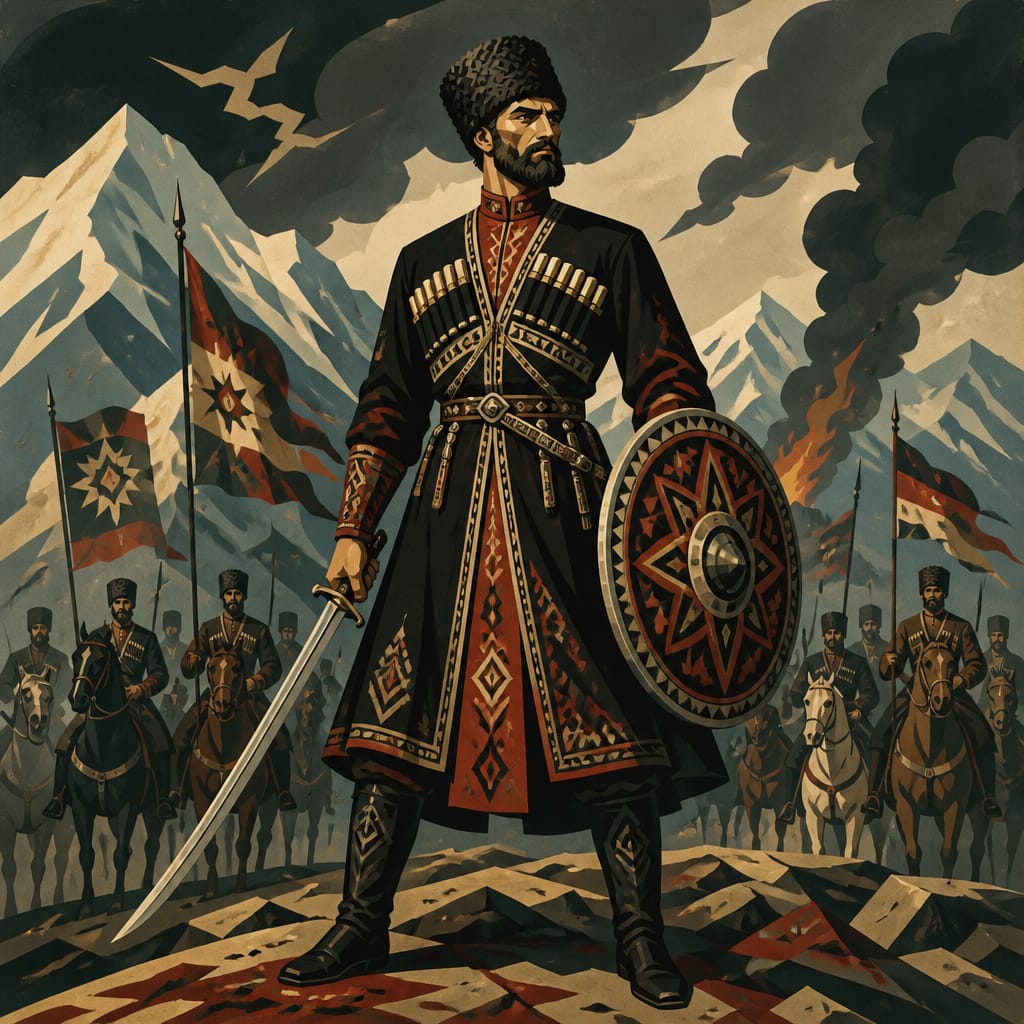
Tetertup
The God of War and Bloodshed.
Mythology
Tetertup is war itself — not the just cause that Shible weighs, but the fact of blood. He was invoked before raids and battles and honoured afterward with a share of the spoil.
The tradition treats him with great caution. Khabze prizes restraint above valour: a warrior who could not sit quietly at a feast was considered a failure regardless of his record. Tetertup is given his due precisely so that he does not have to be given more.
Sacred Correspondences
- ·Battle and bloodshed
- ·Weapons and armour
- ·Courage and fear
- ·The blood feud and its ending
- ·Sun-marked shields
- ·Battlefields
- ·The armoury
- ·Any place a fight is decided
- ·A share of what is won, given away
- ·A weapon laid down and left
- ·Blood-price paid to end a feud
- ·Fasting before a confrontation
- ·Blood red
- ·Black iron
- ·Smoke
- ·Nine
- ·Seven
- ·Do not seek war for glory, plunder, or wounded pride.
- ·Do not harm the unarmed, guests, women, children, or the elderly — an absolute breach.
- ·Do not boast of killing.
- ·Do not carry a feud past the generation that began it.
Establishing a Relationship
Tetertup is not a deity to cultivate for closeness. He is approached only when conflict is already unavoidable, and the right relationship with him is a short, honest, bounded one.
The devotional work is de-escalation: knowing your own temper, ending feuds, laying down what you no longer need to carry. Study conflict so you can end it.
A Ritual
- 1Name a conflict you are carrying and write it on paper.
- 2Set a blade, a stone, or another hard object on the paper.
- 3Say aloud what it has already cost you and others.
- 4Say: "Tetertup, you have had your share. It ends here."
- 5Take the object outside and leave it, bury it, or give it away — do not keep it.
- 6Take one concrete step toward ending the conflict within seven days.
Khabze considers a feud that outlives its cause a disgrace on the family, not a debt of honour.
Rituals presented here are respectful reconstructions drawn from ethnographic description and contemporary Khabze practice, compiled by an outsider for educational purposes. Practice varies by family, village, and diaspora community.