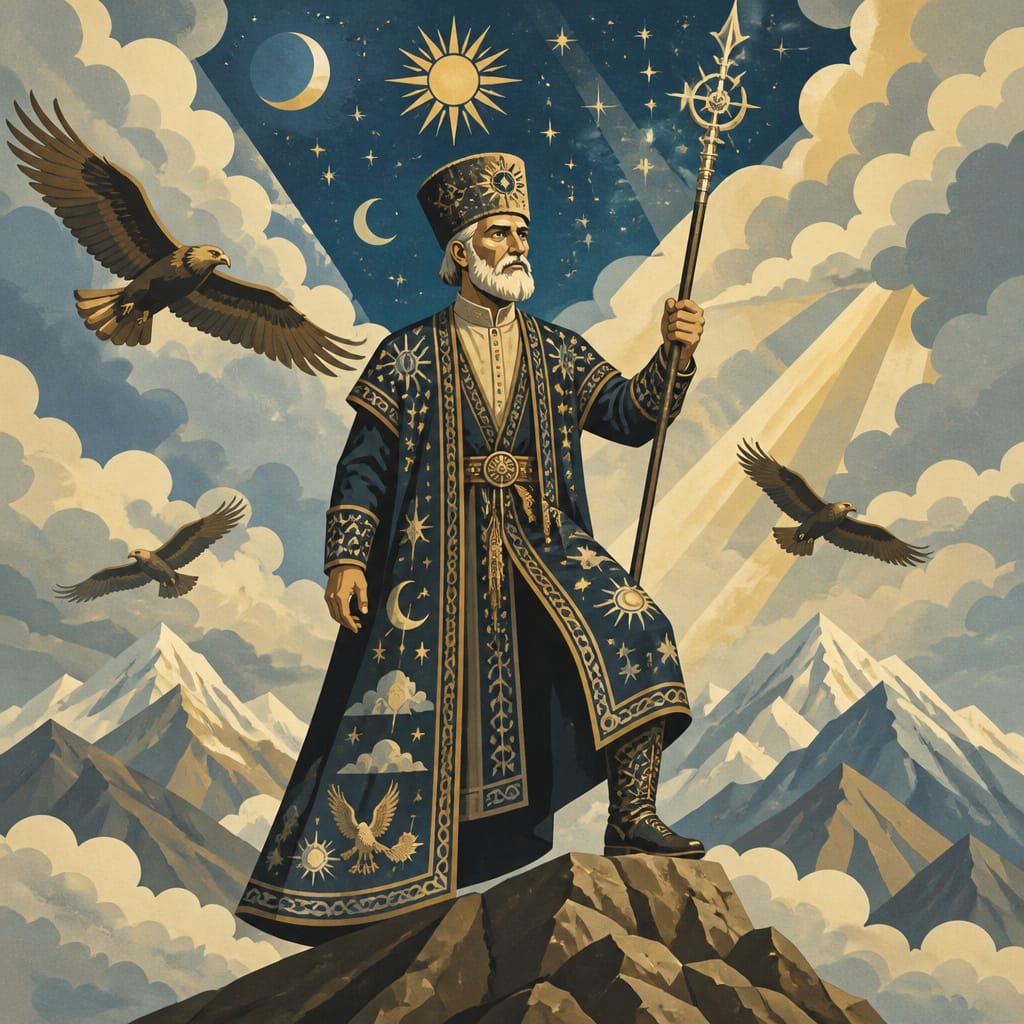
Uashkhue
The God of the Skies.
Mythology
Uashkhue is the sky itself — the vault over the range, and by extension the sacred mountain Uashkhue-mafe, Elbrus, whose twin peaks touch it. Oaths sworn "by the sky" belong to him.
He is old, remote, and unhurried, concerned with the great cycles: the turning stars, the seasons, the long weather. Astronomical observance, calendar-keeping, and the timing of festivals are his.
Sacred Correspondences
- ·Sky, stars, the turning year
- ·Elbrus and high peaks
- ·Oaths sworn openly
- ·Eagles
- ·Calendars and timing
- ·The open sky
- ·Summits
- ·The night sky in clear weather
- ·A night spent watching the stars
- ·An oath spoken under open sky and kept
- ·Smoke rising from a small fire
- ·Keeping the festival dates faithfully
- ·Sky blue
- ·Star silver
- ·Night indigo
- ·Two (the twin peaks)
- ·Twelve (the year)
- ·Do not swear by the sky and then break your word.
- ·Do not make petty requests of him.
- ·Do not neglect the seasonal observances.
- ·Do not roof over a rite that belongs outdoors.
Establishing a Relationship
Uashkhue is a long-horizon deity. Keep a calendar of the solstices, equinoxes, and your own festivals, and observe them for years without missing one.
Learn the constellations visible from where you live. Sleep outdoors occasionally. Make your important commitments under the open sky rather than in a room.
A Ritual
- 1On a clear night, go outdoors where you can see a wide stretch of sky.
- 2Build or light a small fire and let the smoke rise freely.
- 3Stand and look up until your eyes adjust and more stars appear.
- 4Speak one commitment you intend to keep for at least a year.
- 5Say: "Uashkhue, the sky heard it."
- 6Write the date down. Return to the same spot on that date next year and report.
Rituals presented here are respectful reconstructions drawn from ethnographic description and contemporary Khabze practice, compiled by an outsider for educational purposes. Practice varies by family, village, and diaspora community.