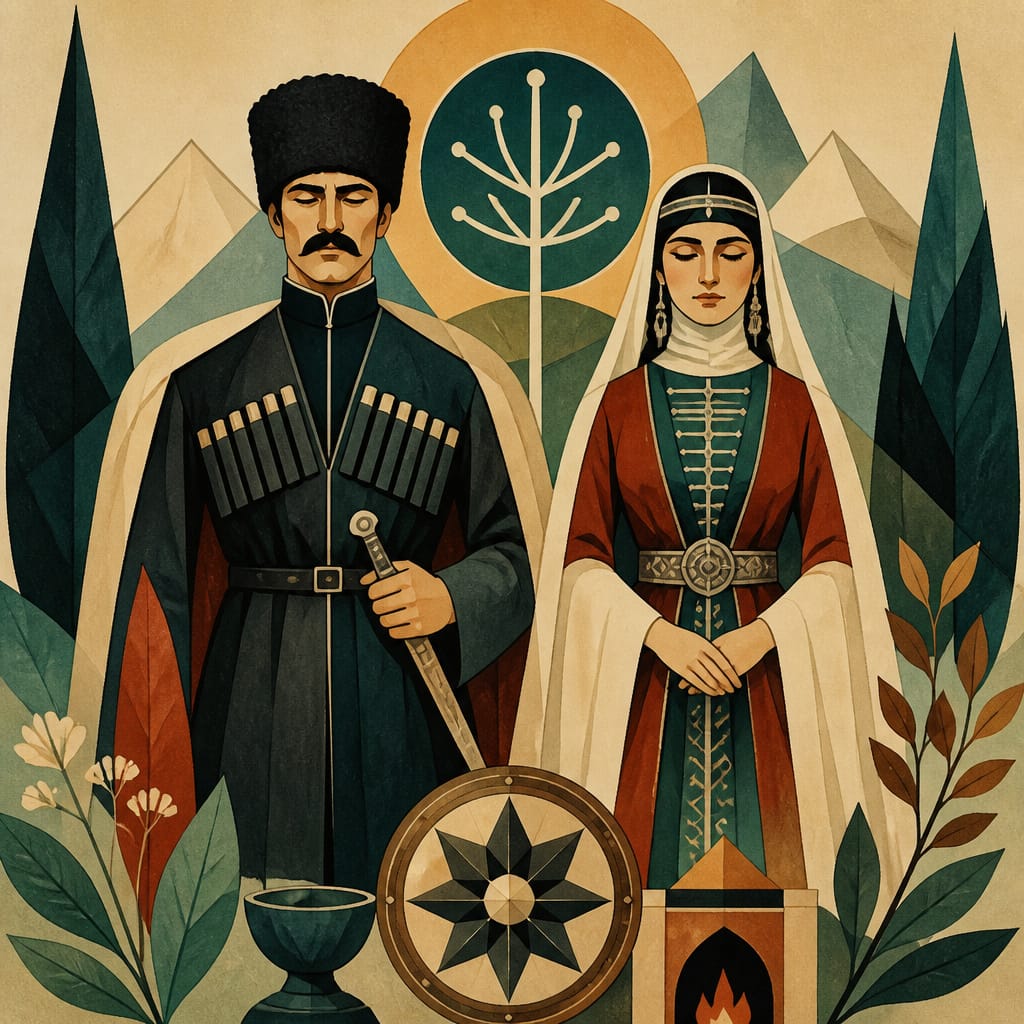
The Wased
Ancestral protectors of the household — guardians of the hearth-line, honored at family rites.
Mythology
The Wased are your own dead, kept close. They remain attached to the hearth-line of the family and are named at rites, weddings, and memorial meals. A household that forgets its Wased is understood to have lost its footing.
They are not distant ancestors in the abstract but specific people: a grandmother's grandmother, a man who built the house. Circassian genealogical memory — often seven generations deep — is a devotional practice as much as a record.
Sacred Correspondences
- ·Family lineage and genealogy
- ·The hearth and the house itself
- ·Memorial meals
- ·Names and naming children
- ·Inherited objects
- ·The family house
- ·The hearth
- ·The family graves
- ·Wherever the family's things are kept
- ·Naming ancestors aloud at meals
- ·Keeping and using an inherited object
- ·A place set at the table
- ·Passing on a family story accurately
- ·Hearth amber
- ·Undyed wool
- ·Old wood brown
- ·Seven (generations remembered)
- ·One (the hearth)
- ·Do not let the family's names be forgotten.
- ·Do not sell or discard an object entrusted to you by the dead.
- ·Do not lie about your lineage.
- ·Do not bring shame on the house and expect their protection.
Establishing a Relationship
Write out your family line as far back as you can reach — names, places, one fact each — and keep adding to it. Ask the oldest living relative you have while you still can.
Speak the names aloud at meals. Keep one inherited object in daily use rather than in storage.
A Ritual
- 1Sit at the hearth or table with a candle and your written family list.
- 2Place an inherited object, or a photograph, beside the candle.
- 3Read the names aloud in order, as far back as you know them.
- 4Where the list ends, say: "Beyond here I do not know you yet, but I will look."
- 5Set out a small portion of food and leave it overnight.
- 6Before the next rite, add at least one new name or one new fact to the list.
Rituals presented here are respectful reconstructions drawn from ethnographic description and contemporary Khabze practice, compiled by an outsider for educational purposes. Practice varies by family, village, and diaspora community.