The Mez
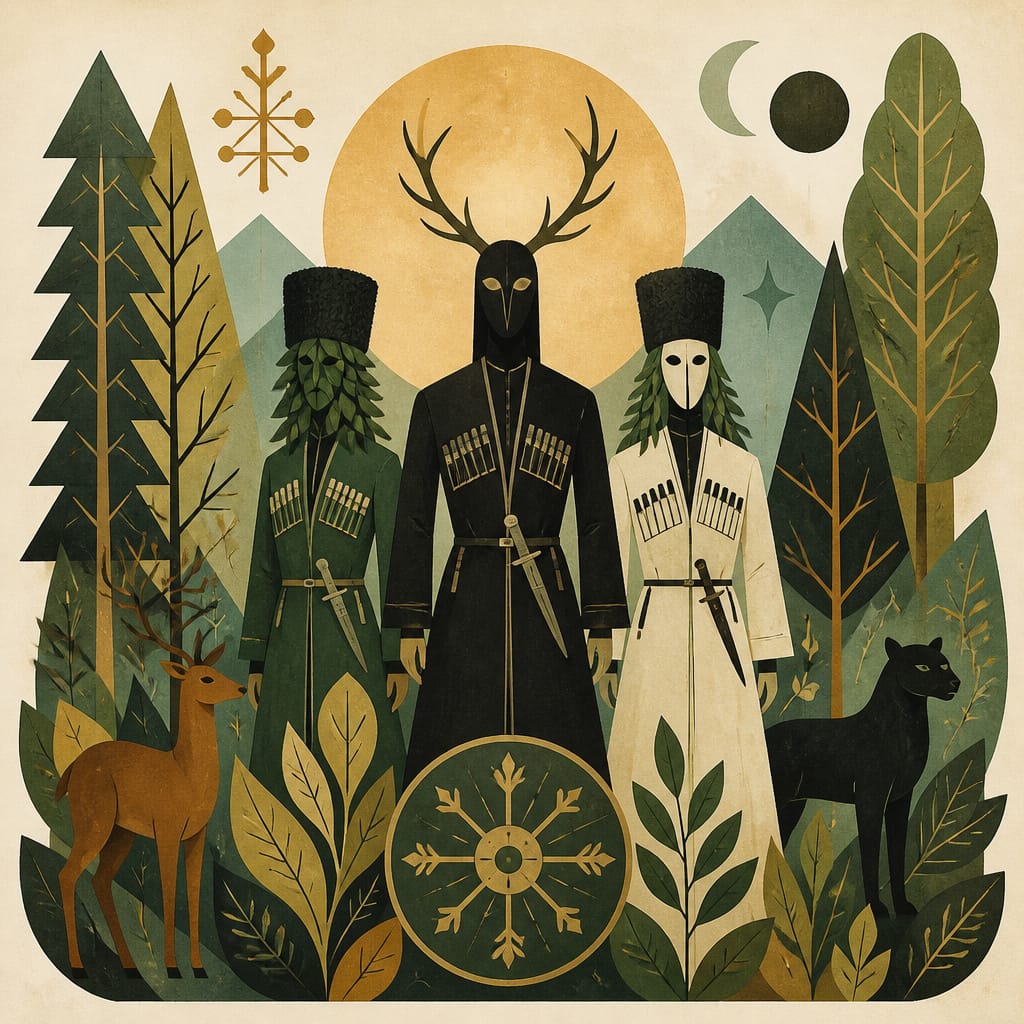
Presences of the forest — the mood of a grove, the watcher in an old walnut.
Mythology
The Mez are the forest's own awareness — the feeling that a grove is occupied, the sudden hush on a game trail, the sense of being permitted or not permitted. Circassian sacred groves were left uncut for centuries because they were understood to be inhabited in this way.
They are not worshipped so much as acknowledged. Masked figures at seasonal rites represent them; the masks are treated carefully and never worn casually.
Sacred Correspondences
- ·Sacred groves and old trees
- ·Walnut, oak, hornbeam
- ·Permission and trespass
- ·Silence in woodland
- ·Masks and seasonal disguise
- ·Uncut groves
- ·Ancient individual trees
- ·Deep forest interiors
- ·Silence kept in the grove
- ·A ribbon on a branch
- ·Bread left at a root
- ·Leaving deadwood where it lies
- ·Leaf green
- ·Bark grey
- ·Shadow
- ·Three
- ·Seven
- ·Do not cut a tree in a sacred grove — the strictest of the forest prohibitions.
- ·Do not enter loudly or unannounced.
- ·Do not carve, mark, or break branches.
- ·Do not wear or handle a rite-mask outside the rite.
Establishing a Relationship
Choose one grove or one old tree and go there without a purpose. Sit, say nothing, take nothing. The relationship is made of accumulated quiet visits.
Defend it practically: oppose its felling, remove its litter, learn its species and its age.
A Ritual
- 1Enter the grove and stop at the first large tree; put a hand on it and ask permission silently.
- 2Walk in without speaking and choose a place to sit with your back to a trunk.
- 3Sit for at least a quarter of an hour, doing nothing at all.
- 4Leave a piece of bread at the roots and tie a ribbon if the grove feels welcoming.
- 5Leave by the same path, still silent.
- 6Speak only once you are past the treeline, and say thanks aloud there.
Rituals presented here are respectful reconstructions drawn from ethnographic description and contemporary Khabze practice, compiled by an outsider for educational purposes. Practice varies by family, village, and diaspora community.