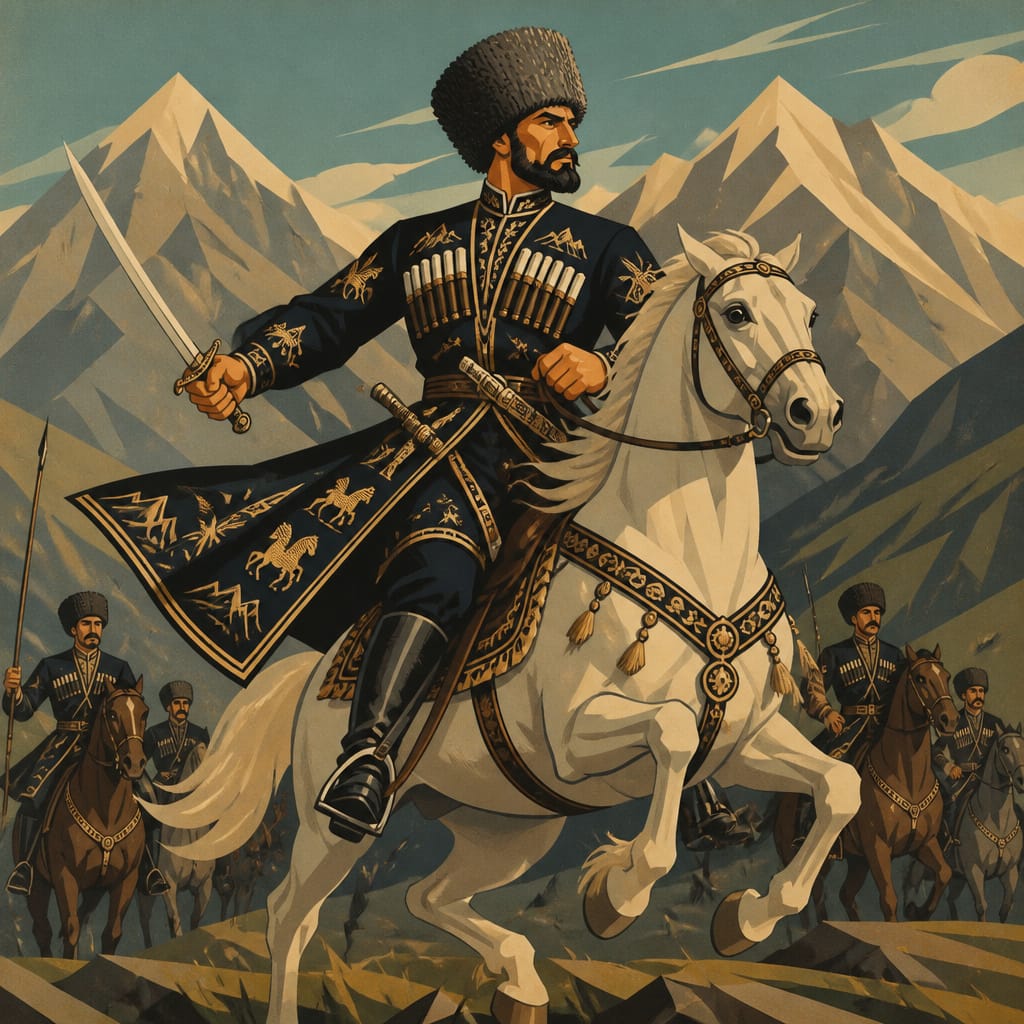
Theshu
The God and Protector of Horsemen.
Mythology
The Circassian horse and the Circassian rider were famous across two empires, and Theshu is the god of both. He guards the traveller on the road, the horse under him, and the code that governs how a rider behaves toward strangers.
Riders asked his protection at the start of a journey and thanked him at the end. He is closely bound to the ethics of the road: escorting a guest to safety, never riding down the weak, treating the horse as a companion rather than a tool.
Sacred Correspondences
- ·Horses and horsemanship
- ·Travel and safe roads
- ·Courage and skill
- ·Escort and protection of guests
- ·The saddle and bridle
- ·Roads and mountain tracks
- ·Stables
- ·The open steppe
- ·Departures and arrivals
- ·Care given to an animal that carries you
- ·A horsehair tied at a crossroads
- ·Bread broken at the start of a journey
- ·Escorting a traveller part of their way
- ·Chestnut
- ·White (the horse)
- ·Road dust grey
- ·Four (the hooves)
- ·Three
- ·Do not overwork, strike in anger, or neglect a horse or any working animal.
- ·Do not abandon a traveller in trouble on the road.
- ·Do not use speed or strength against someone weaker.
- ·Do not begin a long journey without a word to him.
Establishing a Relationship
Theshu belongs to anyone who travels or carries others. Mark the start and end of every significant journey with a spoken word — this is the whole discipline.
Maintain whatever carries you, whether a horse, a bicycle, or a car, as an act of respect. Stop for people stranded on the road.
A Ritual
- 1Before leaving, stand at the threshold or beside your horse or vehicle.
- 2Put a hand on it and say where you are going and who is waiting for you.
- 3Break a piece of bread; eat half, leave half at the doorstep or crossroads.
- 4Say: "Theshu, ride with me, and bring me back whole."
- 5On the road, offer help at least once — a lift, a hand, directions.
- 6On arrival, thank him aloud before doing anything else, and tend to whatever carried you before yourself.
Rituals presented here are respectful reconstructions drawn from ethnographic description and contemporary Khabze practice, compiled by an outsider for educational purposes. Practice varies by family, village, and diaspora community.