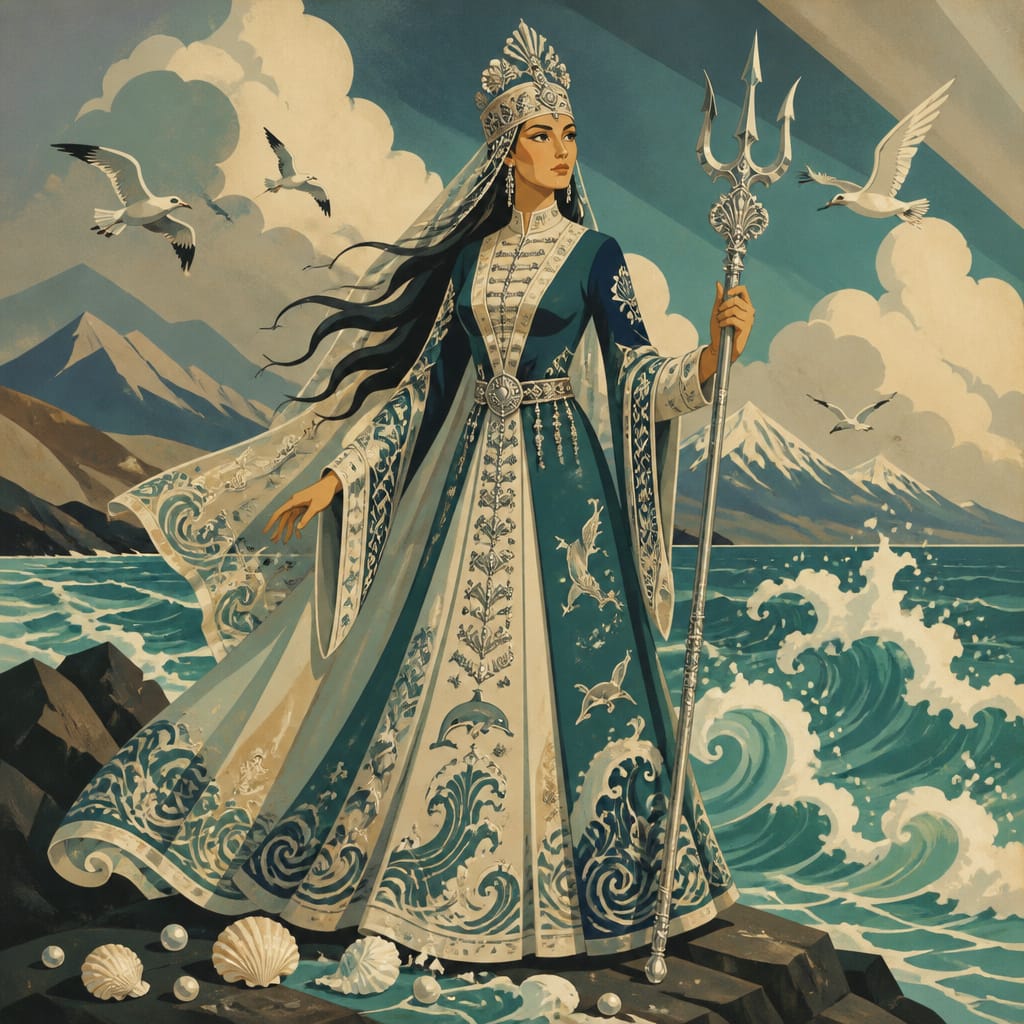
Heneguash
The Goddess of the Sea.
Mythology
Heneguash rules the Black Sea coast that borders the Circassian homeland — the sea of trade and of the 1864 exile. She is vast, unsentimental, and older than any village.
For the diaspora, she carries a second weight: the crossing. Memorial rites on the shore in late May address her as the keeper of those who did not survive the ships, and she is invoked wherever Circassians live within reach of salt water.
Sacred Correspondences
- ·The sea and coastline
- ·Storms and safe passage
- ·Salt
- ·Exile and diaspora memory
- ·Seabirds
- ·The Black Sea and all salt water
- ·Harbours and shorelines
- ·Ships underway
- ·Flowers cast on the waves
- ·Salt returned to the sea
- ·A stone carried from home and set at the tideline
- ·Cleaning a beach
- ·Sea green
- ·Storm grey
- ·Foam white
- ·Seven
- ·Twenty-one (May 21, the day of mourning)
- ·Never pollute the sea or leave waste on a shore.
- ·Do not boast of your seamanship or defy a storm.
- ·Do not take shells, stones, or life from a shore in quantity.
- ·Do not make light of the exile in her presence.
Establishing a Relationship
Go to salt water and stay long enough to be bored — she does not respond to short visits. Learn the tide table of your nearest coast.
Mark May 21 at the shoreline if you can. Carry a small stone from a place that matters to you and give it to her when you are ready to let something go.
A Ritual
- 1Go to the shore at dusk with flowers and a small stone.
- 2Stand where the water can reach your feet and let it, without stepping back.
- 3Name aloud what you are grieving or releasing.
- 4Cast the flowers on an incoming wave.
- 5Set the stone at the tideline and leave it for the sea to take.
- 6Before leaving, pick up whatever litter you can carry.
Rituals presented here are respectful reconstructions drawn from ethnographic description and contemporary Khabze practice, compiled by an outsider for educational purposes. Practice varies by family, village, and diaspora community.