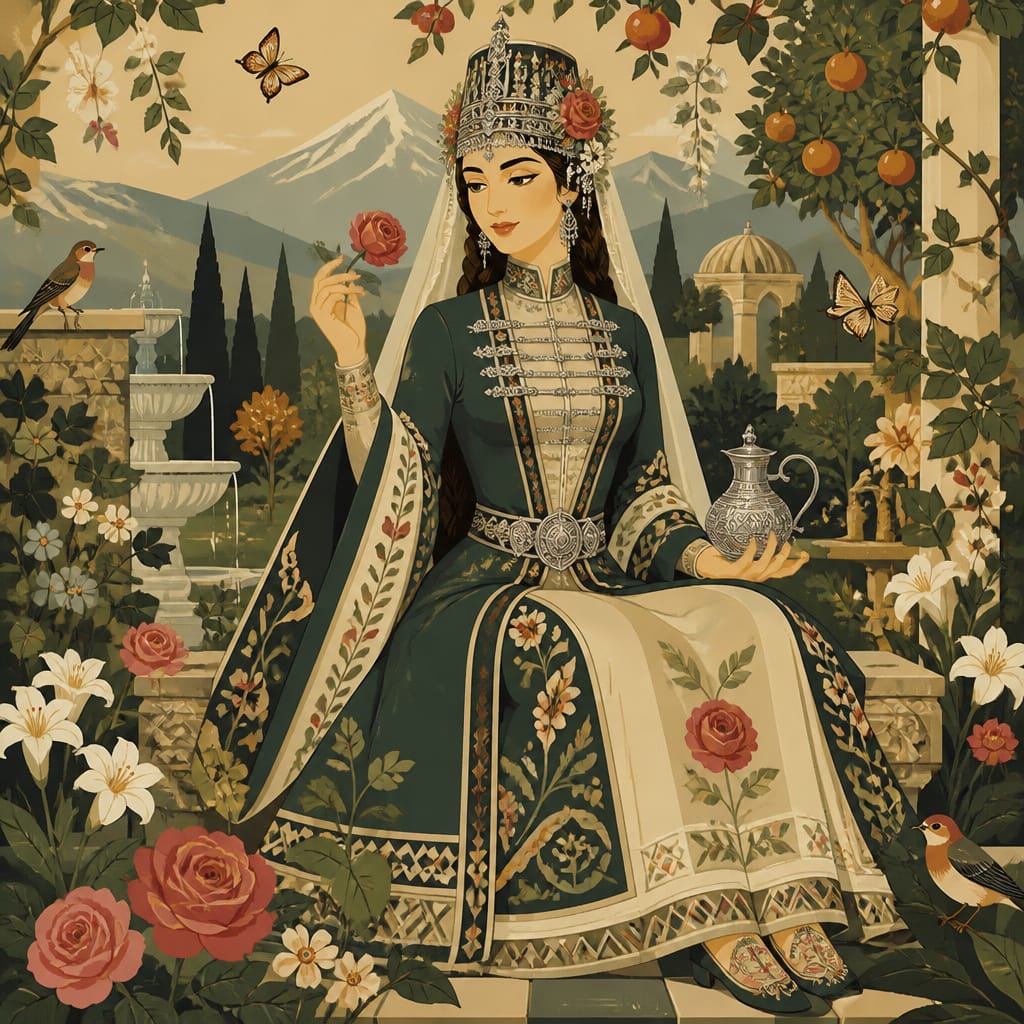
Hyateguash
The Goddess of Beauty and Gardens.
Mythology
Hyateguash presides over cultivated beauty — the garden rather than the wilderness, the embroidered sleeve rather than the raw cloth. In Khabze, beauty is not decoration but an ethical category: a well-kept garden, like well-kept manners, is evidence of a person's inward order.
She is associated with roses, fountains, and the fine gold-thread embroidery Circassian women were famed for. Her gifts arrive slowly and require tending.
Sacred Correspondences
- ·Gardens and flowers
- ·Roses and fruit blossom
- ·Embroidery and craft beauty
- ·Grace of manner
- ·Fountains and ornamental water
- ·Cultivated gardens and orchards
- ·Courtyards
- ·The workroom where fine work is done
- ·Planting something you will not see mature
- ·Cut flowers set at a window
- ·A finished piece of needlework
- ·Rosewater
- ·Rose pink
- ·Garden green
- ·Gold thread
- ·Five (the petals)
- ·Twelve
- ·Do not tear up or trample flowers carelessly.
- ·Do not mock another person's appearance.
- ·Do not let a garden in your charge go to ruin from indifference.
- ·Do not treat beauty as vanity, or vanity as beauty.
Establishing a Relationship
Tend one growing thing continuously — a bed, a pot, an orchard. She notices maintenance rather than gestures.
Take up a decorative craft and practice it badly for a long time. Make your surroundings beautiful for people other than yourself.
A Ritual
- 1Choose a plant that will take years to reach its full growth.
- 2Prepare the ground carefully and by hand, without rushing.
- 3Before planting, say aloud who you are planting it for — someone other than yourself.
- 4Set it in, water it, and place a flower or a coloured thread beside it as her portion.
- 5Say: "Hyateguash, I will not see this finished."
- 6Return to water and tend it on a schedule you commit to out loud.
Rituals presented here are respectful reconstructions drawn from ethnographic description and contemporary Khabze practice, compiled by an outsider for educational purposes. Practice varies by family, village, and diaspora community.