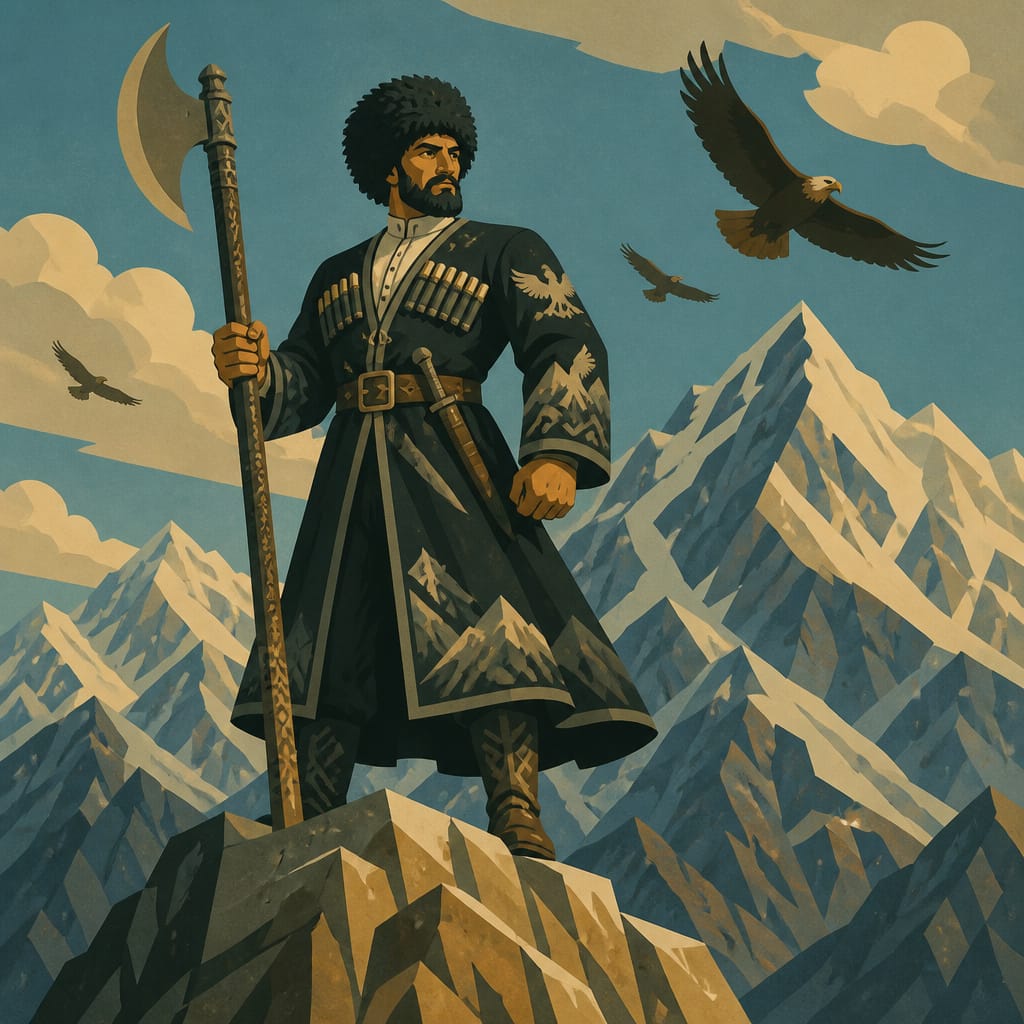
Kodes
The God of Mountains.
Mythology
Kodes is the weight and stubbornness of the Caucasus itself. The range is not scenery in Circassian thought — it is the reason a small people kept its language and law for centuries. Kodes is that fact personified: endurance, refuge, and hard ground.
He is invoked at passes and summits, by travellers and by anyone who has to hold a position. Eagles are his messengers; the axe and the standing stone are his emblems.
Sacred Correspondences
- ·Mountains, peaks, passes
- ·Endurance and refuge
- ·Stone and rockfall
- ·Eagles
- ·Boundaries
- ·Summits and high passes
- ·Cliffs and scree
- ·Any place of shelter in hard country
- ·A stone added to a cairn
- ·Water poured at a summit
- ·Bread eaten at the top and a piece left
- ·Carrying someone else's load uphill
- ·Granite grey
- ·Snow white
- ·Deep blue shadow
- ·Two (the twin peaks of Uashkhue-Elbrus)
- ·Nine
- ·Do not climb carelessly or endanger others to prove something.
- ·Do not litter or deface high places.
- ·Do not dismantle a cairn.
- ·Do not complain about the ascent aloud.
Establishing a Relationship
Kodes is met by walking uphill regularly. Pick a hill or a high point you can reach and climb it in all weathers, over years.
When you face something long and immovable, take it to him rather than asking for it to be removed. He grants endurance, not relief.
A Ritual
- 1Choose a stone at the bottom of a climb — heavy enough to be inconvenient.
- 2Name aloud the thing you must endure, and carry the stone for it.
- 3Climb without setting the stone down, resting as often as you need.
- 4At the top, place it on a cairn or build one, and say: "Kodes, hold this as long as I must."
- 5Eat and drink there; leave a portion of bread on the stone.
- 6Descend by a different way if you can.
Rituals presented here are respectful reconstructions drawn from ethnographic description and contemporary Khabze practice, compiled by an outsider for educational purposes. Practice varies by family, village, and diaspora community.