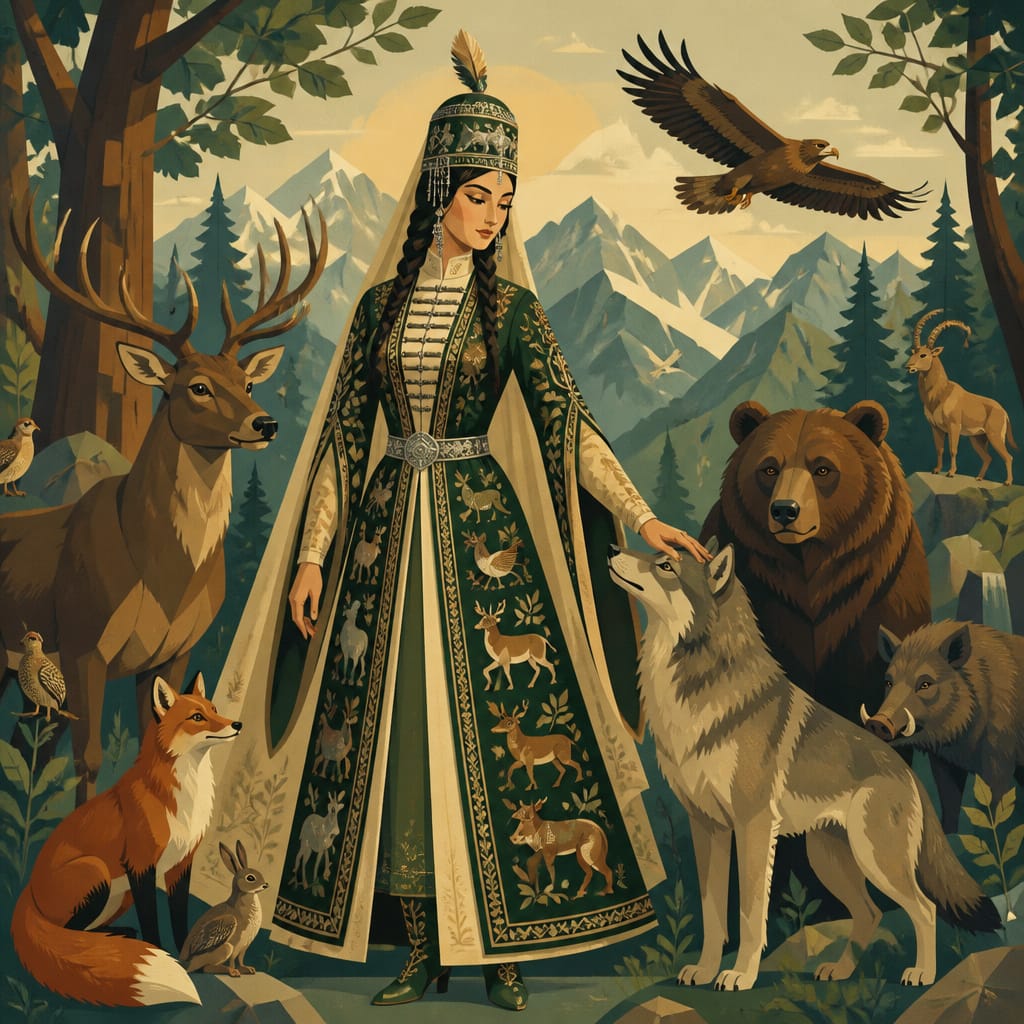
Mezguash
The Goddess of all Fauna.
Mythology
Where Mezythe governs the hunt, Mezguash is the mother of the animals themselves — bear and wren alike, hunted and unhunted. She is described walking in the forest with every species at ease around her, none fleeing and none preying.
She is the conscience of the hunt: the presence that makes cruelty unthinkable rather than merely forbidden. Wounded animals are her particular concern.
Sacred Correspondences
- ·All wild animals
- ·Motherhood among beasts
- ·Mercy and rescue
- ·Birdsong
- ·Spring births
- ·Forest and meadow
- ·Dens, nests, burrows
- ·Anywhere an animal is in distress
- ·Feeding wild birds through winter
- ·Rescuing or treating an injured animal
- ·Leaving part of a garden wild
- ·Water set out in drought
- ·Moss green
- ·Fawn brown
- ·Feather grey
- ·Four (the legs)
- ·Countless
- ·Never cause an animal unnecessary suffering.
- ·Do not take young from a nest or den.
- ·Do not keep a wild animal captive for amusement.
- ·Do not kill what you will not use.
Establishing a Relationship
Mezguash asks for practical mercy. Learn the animals of your own area by name and habit. Do something inconvenient for one of them regularly.
Her relationship deepens through small, repeated acts of care rather than through any rite: the fed bird, the moved snail, the fenced-off nesting patch.
A Ritual
- 1Set aside a defined patch — a corner of a garden, a windowsill, a bowl — as hers, permanently.
- 2Put out food and clean water appropriate to your local wildlife.
- 3Say aloud: "Mezguash, this part is not mine."
- 4Sit nearby, still and silent, for as long as it takes to see or hear one wild animal.
- 5Name it aloud and thank it.
- 6Maintain the patch year-round; never take it back.
Rituals presented here are respectful reconstructions drawn from ethnographic description and contemporary Khabze practice, compiled by an outsider for educational purposes. Practice varies by family, village, and diaspora community.