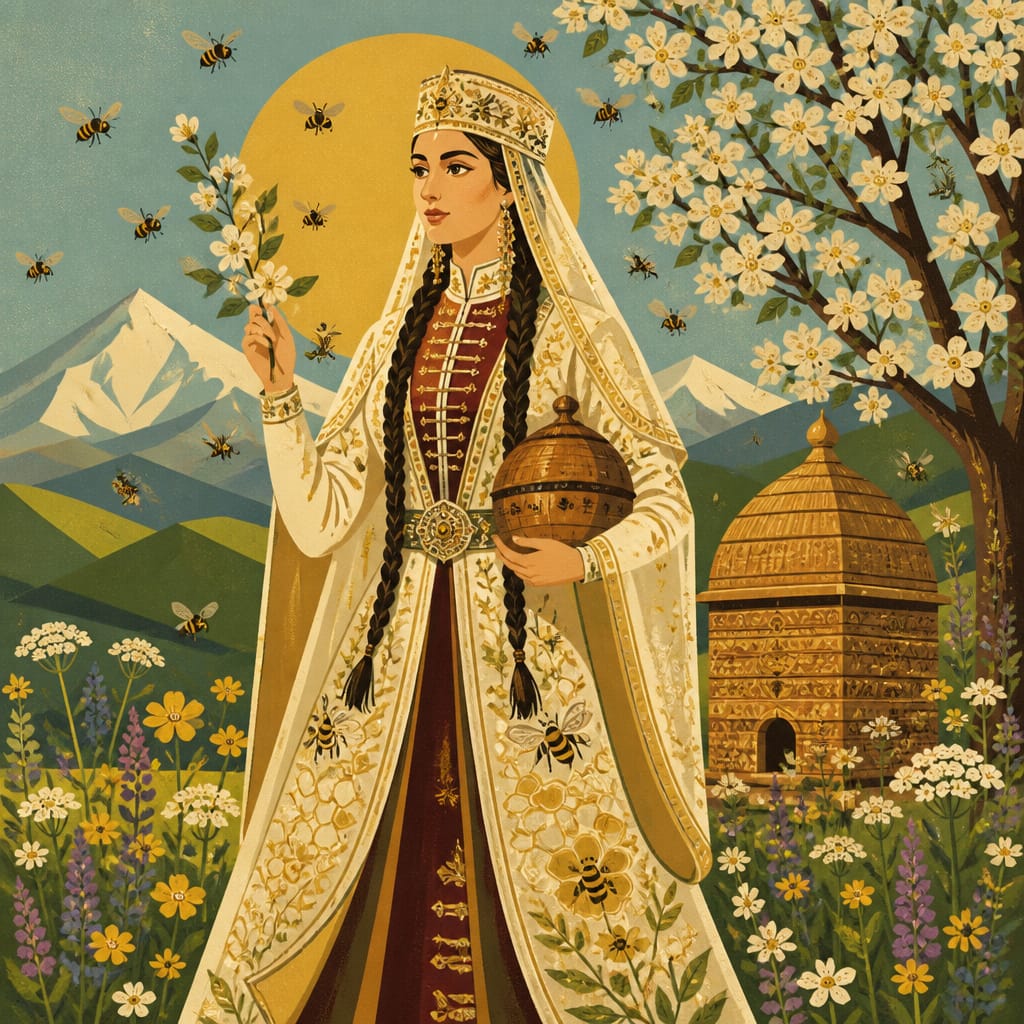
Merise
The Goddess and Protectress of Bees.
Mythology
Merise saved the bees. In the story, a plague or a killing winter destroyed every hive in the world but one, which she hid and kept alive until the swarms could return. Circassian beekeeping — and the honey that sweetened its ritual drink — descends from that single sheltered hive.
She is gentle but exacting, the deity of the small industrious thing whose loss would be catastrophic. Beekeepers spoke to her before opening a hive.
Sacred Correspondences
- ·Bees and hives
- ·Honey and mead
- ·Pollination and orchards
- ·Diligence and cooperative work
- ·Sweetness given, not taken
- ·Hives and apiaries
- ·Flowering meadows and orchards
- ·The hollow tree
- ·Honey returned to the earth or left at a hive
- ·Planting flowers for pollinators
- ·Water set out for bees in summer
- ·A share of any harvest of honey
- ·Honey gold
- ·White
- ·Blossom pink
- ·One (the surviving hive)
- ·Six (the cell)
- ·Never kill bees or destroy a hive.
- ·Do not take all the honey; always leave the colony enough.
- ·Do not use poisons where pollinators feed.
- ·Do not open a hive in anger or haste.
Establishing a Relationship
Merise responds to habitat, not prayer. Plant for pollinators, stop using pesticides, put out water. Buy honey from someone whose bees you could go and look at.
Her rhythm is patient, cooperative labour — small contributions to a shared store. Join something collective and do your unglamorous part in it.
A Ritual
- 1Set a shallow dish of water with stones in it where bees can drink, in a sunny place.
- 2Plant or place at least one flowering plant beside it.
- 3Put a spoonful of honey on a leaf or stone as her portion.
- 4Say: "Merise, one hive was kept; let these be kept too."
- 5Sit and watch until a pollinator comes.
- 6Refill the water all summer without fail.
Rituals presented here are respectful reconstructions drawn from ethnographic description and contemporary Khabze practice, compiled by an outsider for educational purposes. Practice varies by family, village, and diaspora community.