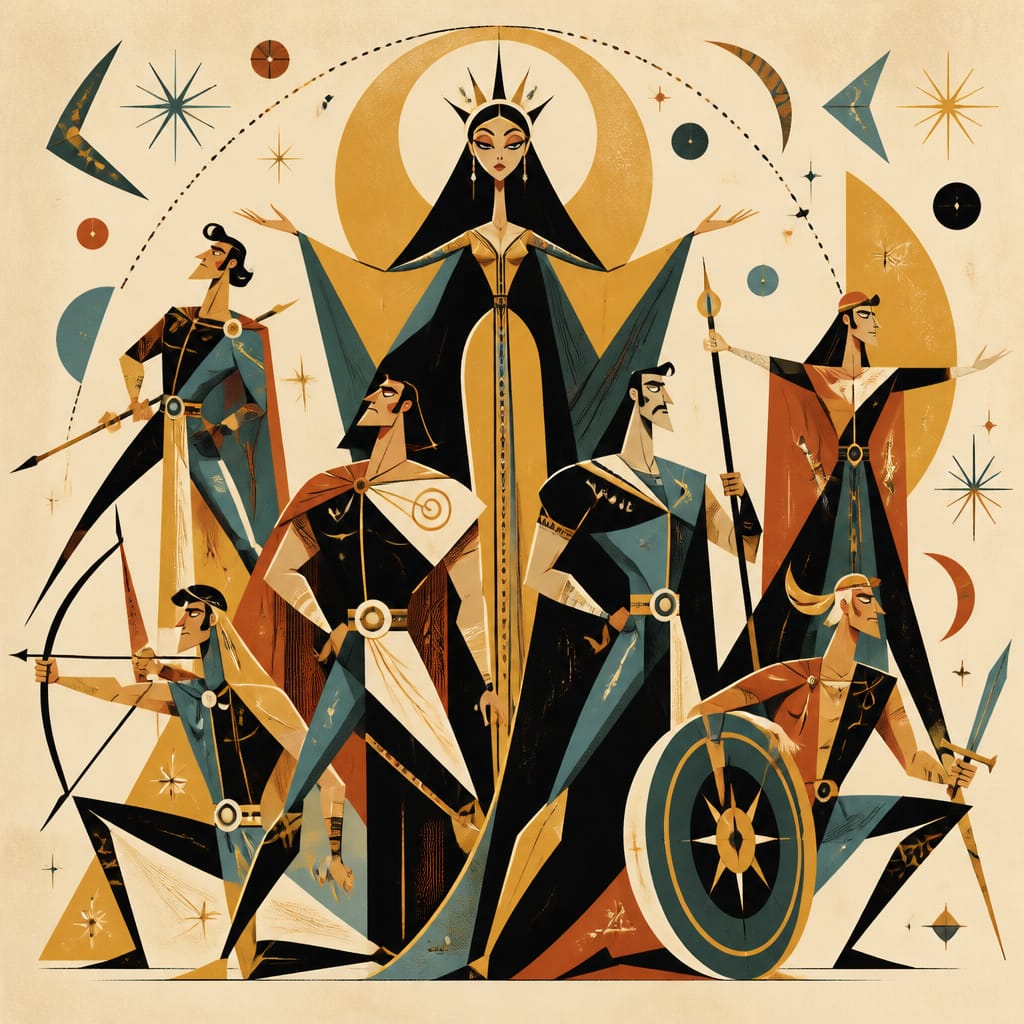
The Narts
Demigods of the eponymous Saga, born of their mother Sataney.
Mythology
The Narts are the heroic race who lived in the age before ours: Sosruko born of stone and tempered by Tlepsh, Batraz of the steel heart, Pataraz the avenger, Ashamez with his magic flute, and Sataney their mother and counsellor.
Their stories are not scripture. They are the tradition's mirror — a way of teaching honor, cunning, restraint, and grief through narrative. The Narts are magnificent and frequently wrong; the sagas are as interested in their failures as their victories.
At the end of the cycle the Narts are offered a choice between long life with small deeds and short life with lasting fame, and they choose the latter. That choice is the moral hinge of the whole tradition.
Sacred Correspondences
- ·Heroism and its costs
- ·Storytelling and oral memory
- ·Feasting and the council
- ·Ancestral example
- ·Fire stolen and given
- ·The Nart council-ground
- ·The feast hall
- ·The mountain passes of the old age
- ·Any circle where a story is told
- ·Telling one of their tales aloud, well
- ·A cup of makhsyma poured at a feast
- ·Teaching a young person a story by heart
- ·Sitting through a long telling without interrupting
- ·Iron grey
- ·Firelight orange
- ·Wine dark
- ·Seven
- ·One hundred (the Nart host)
- ·Do not rewrite or moralise their stories to make them comfortable.
- ·Do not tell a saga badly out of haste.
- ·Do not imitate their arrogance while ignoring their courage.
- ·Do not interrupt an elder telling a tale.
Establishing a Relationship
The Narts are approached as ancestors, not gods: you keep faith with them by keeping their stories. Learn one saga by heart and tell it aloud to real people, repeatedly, until you tell it well.
Read widely across the variants — Circassian, Abkhaz, Ossetian. Notice where the hero is wrong, and say so when you tell it.
A Ritual
- 1Gather at least two listeners around a fire, candle, or lamp after dark.
- 2Pour a cup of makhsyma, wine, or ale and set it where nobody will drink it.
- 3Open by naming the Narts and their mother Sataney.
- 4Tell one saga from memory, without notes, however imperfectly.
- 5Let the listeners say what they think the hero got wrong.
- 6Pour the untouched cup onto the ground outside at the end of the night.
Rituals presented here are respectful reconstructions drawn from ethnographic description and contemporary Khabze practice, compiled by an outsider for educational purposes. Practice varies by family, village, and diaspora community.